
Block Party
A daily classic LITS logic puzzle.
Loading your friend’s challenge…
Block Party
Today's block is on its way.
Today's block
Time 0:00
One block: not yet
- Shaded: part of a piece
- Dot: marked open
- ! Red: a rule broken
- L Glow and letter: a clean piece
Tap to shade, again to mark open, again to clear; drag to paint. Keys: arrows move, Space shades, X marks, Backspace clears, U undo, Enter checks.
Tap a cell to shade it; tap again to mark it open.
Set the block to file your time.
Next party at midnight UTC.
How everyone did today appears here once 20 players have finished.
0Played
0Set
0Win %
0Streak
0Best streak
0No hint
Best times: none yet.
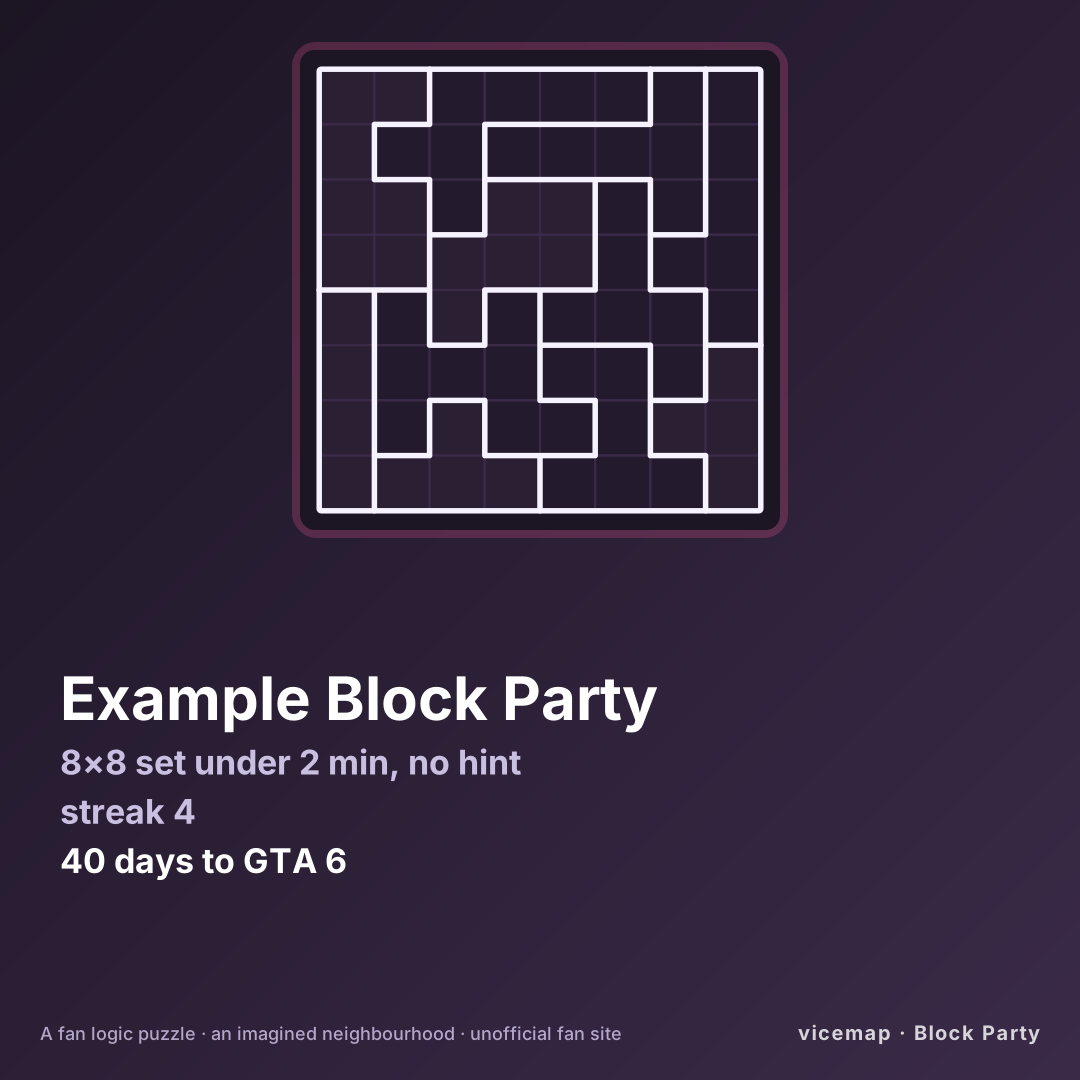
Today's card shows the block map with its districts only, your time band, streak and the days to launch; a card for an earlier day shows that day's pieces. Never today's answer.
Drop one building footprint into every district of an imagined Leonida block map: shade exactly four joined cells in every outlined district as an L, I, T or S, keep every shaded cell in one block, never fill a 2×2, and never let two pieces of the same shape touch. An 8×8 block on weekdays, the harder "Festival night" 10×10 at the weekend, a 6×6 warm-up, tap or drag to shade, live district borders and rule checks, one hint, a streak, personal bests and a spoiler-free result to share. A fan puzzle about an imagined neighbourhood, never map data.
How to play
The grid is an imagined neighbourhood seen from above, cut into outlined districts, and the block party needs one new building footprint in each. Shade exactly four cells joined edge to edge in every district so that they form an L, an I, a T or an S (turned or flipped any way); every shaded cell in the grid must join up into one block; no 2×2 square may be fully shaded; and two pieces of the same shape may never share an edge across a district border. Tap a cell to shade it, again to mark it open, again to clear it, or drag to paint a run. A district holding a clean piece glows, takes the tint of its shape and shows its letter; a cell that breaks a rule turns red; the one-block light comes on when everything joins up. The checks only ever look at the rules, never at the answer. Undo and Clear all are there when a piece goes wrong. Every board is checked when the site is built by a solver that runs the same rules you use (a district of exactly four cells is shaded whole; a cell every possible piece covers is shaded and one no piece reaches stays open; a piece that would complete a 2×2 or touch a finished piece of the same shape is out; then, at the weekend, the two-district argument, where a piece with no partner that fits beside it next door is out, and the connectivity cut, where a piece that would split the block is out) and then tries the rest, so each has exactly one answer; the warm-ups fall to the simplest steps alone, the weekday blocks sometimes need the second level and the Festival nights always do, but never trial and error.
Everyone gets the same block on the same UTC day: an 8×8 on weekdays, the harder Festival night 10×10 at the weekend, and newcomers can switch on the 6×6 warm-up, which still counts. One hint a day places one cell the rules force, says which rule, and marks the result as assisted. When the last piece lands and every rule holds, the districts light up one by one, the lanterns come on with a burst over the block, and the party organiser signs off with your time; Give up shows the answer and ends the day without a party. The archive lets you play any earlier day's block and practice blocks come from a spare pool; both are marked and never count. Block Party is a fan puzzle about an imagined neighbourhood: the districts are abstract shapes from a generator and never traced from any map, nothing here is a place, a street, a business or an asset from GTA 6, nothing comes from a leak, and nothing is presented as official. For more deduction try Neon Tally, Lot Lines and Key Islands.
Questions
What are the rules?
Classic LITS on an imagined block map. Shade exactly four cells joined edge to edge in every outlined district so that they form an L, an I, a T or an S (turned or flipped any way). Every shaded cell in the whole grid must join up into one block, no 2×2 square may be fully shaded, and two pieces of the same shape may never share an edge across a district border. Every board here has exactly one answer.
How do I shade a cell?
Tap a cell to shade it, tap again to mark it open (a dot), tap again to clear it. Drag across cells to paint the same state along the way. Mark switches a tap to the open dot and back. On a keyboard the arrows move, Space shades, X marks a cell open, Backspace clears, M toggles mark mode, U undoes, Enter checks, Escape drops the focus. Undo takes back the last change (a whole drag in one go); Clear all empties the block map.
What do the highlights mean?
A district whose shaded cells are a clean L, I, T or S glows, takes the tint of its shape and shows the piece letter in its corner, so two pieces of the same shape side by side are easy to spot. A cell turns red when its district has more than four shaded cells or four that are no piece, when it sits in a fully shaded 2×2, or when its piece touches another of the same shape. The "one block" light comes on when every shaded cell is joined up. The checks only ever look at the rules, never at the answer. One hint a day places one cell a named rule forces and says which in words ("the district at row 2, col 5 is exactly four cells: shade it all"; "shading row 4, col 3 would complete a 2×2 block, so it stays open"), and marks the result as assisted. Give up shows the answer and ends the day without a party.
What is the warm-up?
A 6×6 block map for newcomers, switched on with the Warm-up toggle (remembered on this device). Every warm-up falls to the simplest steps alone: districts of exactly four cells, cells every piece covers or none reaches, the 2×2 block and same-shape separation. It counts as the day's solve; the 8×8 and 10×10 blocks are what the best times are about.
Is this a real map or official content?
No. Block Party is a fan logic puzzle about an imagined neighbourhood. The districts are abstract shapes drawn by a generator and never traced from any map, nothing here is a place, a street, a business or an asset from the game, nothing comes from a leak, and nothing is presented as official. For the real places people are talking about, see the places and regions guides on this site.
Keep exploring
Daily games: 29 pages to explore
 GTA 6 newsFresh GTA 6 headlines from major gaming sites, gathered automatically every 30 minutes.
 GTA 6 glossaryThe names, places and terms you will meet on this site and in official GTA 6 coverage, explained in one line each,…
 Leonida DailyA new GTA 6 puzzle every day. Read the clue, find the right region of Leonida on the map, then answer five trivia…